
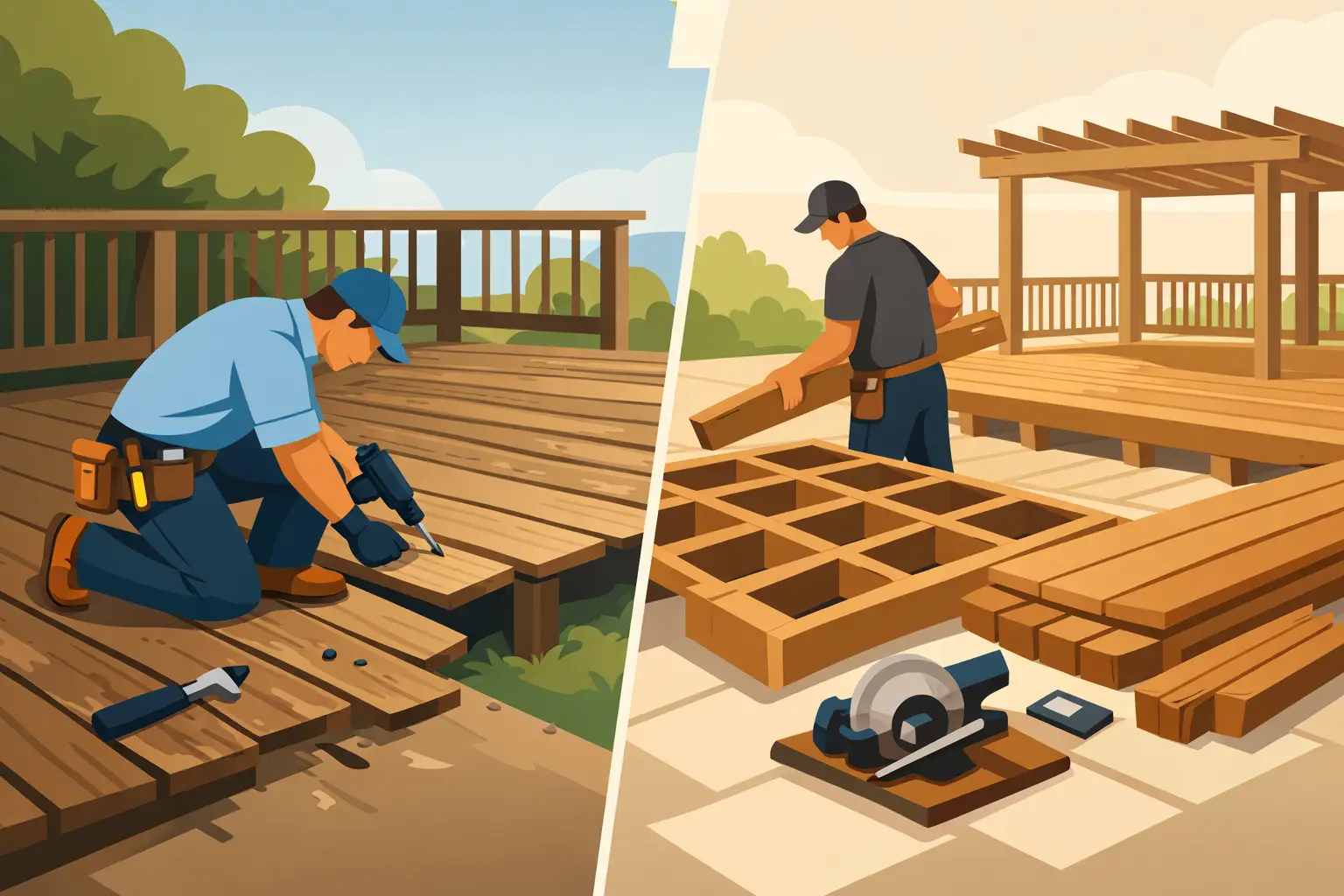
A deck can look tired long before it is actually failing. Loose rails, cracked boards, popped fasteners, and soft spots all raise the same question for homeowners: deck repair vs rebuild. The right answer depends on what is happening underneath the surface, not just what you can see from the yard.
That is where many deck decisions go sideways. A few bad boards do not always mean you need a brand-new structure. On the other hand, a fresh coat of stain and some replacement decking will not solve framing problems, movement, rot, or code issues. If you want the project to last, the decision has to be based on safety, service life, and overall value.
Deck repair vs rebuild starts with the frame
The decking boards are only one part of the system. The frame, posts, footings, stairs, railings, and connection points all matter. If the structure underneath is solid, a repair can often buy you meaningful time and improve appearance at a reasonable cost.
If the framing is compromised, the conversation changes fast. Rot in joists, weak ledger attachment, failing stairs, or movement at the posts are not cosmetic problems. They affect whether the deck is safe to use at all. In those cases, rebuilding is usually the better investment because you are not spending good money trying to rescue a structure that has already reached the end of its service life.
This is why a real inspection matters. Homeowners often focus on the top surface because that is what they walk on every day. Experienced contractors look below that surface first.
When deck repair makes good sense
Repair is the right path when the deck has isolated problems and the main structure is still sound. That usually means the joists are in good condition, the posts are stable, the ledger is properly attached, and there is no widespread rot or major shifting.
A repair also makes sense when the issues are concentrated in a few components. You might have several cracked deck boards, one damaged stair tread, or a railing section that no longer feels secure. Those are fixable problems if the rest of the deck is performing the way it should.
Age matters too, but it is not the only factor. A well-built deck that has been maintained can still be worth repairing even after many years. A poorly built deck with shortcuts in flashing, fastening, or framing can become a rebuild candidate much sooner.
In practical terms, repair is often the smart choice when you want to extend the life of the deck, improve safety, and hold off on a larger investment for a few more years. It can also be a sensible move if you are planning broader exterior upgrades and want to phase the work in a way that fits your budget.
Signs a repair may be enough
If the problems are mostly on the surface, that is a good sign. Split boards, worn stain, a few loose fasteners, or minor railing issues are typically repair territory. Localized rot in a small area can also sometimes be addressed, provided the damage has not spread into structural members.
Another good sign is consistency. If the deck feels stable underfoot, the stairs are firm, the railings are properly secured, and there is no visible sagging, you may be dealing with age and wear rather than structural failure.
That said, repairs still need to be done correctly. Swapping boards without addressing drainage, flashing, or fastening details only delays the next problem.
When rebuilding is the smarter move
Sometimes the best value comes from starting over. That can sound like the more expensive option, but patching a failing deck can become the costlier decision if you keep repairing one part after another.
Rebuilding usually makes more sense when there is widespread deterioration, not just isolated damage. If multiple structural members are rotted, the deck has visible sagging, the stairs are failing, or the framing no longer meets current expectations for safety and performance, it is often better to build new.
A rebuild is also worth serious consideration if the deck layout no longer works for how you use your home. Many older decks were built smaller, with narrow stairs, dated rail systems, and little thought to traffic flow or outdoor living. If you are already facing major structural work, that is the moment to decide whether you want to keep the same footprint or create something that actually fits your needs.
For many homeowners, this is the tipping point in the deck repair vs rebuild decision. If the deck is unsafe and outdated, rebuilding gives you the chance to solve both problems at once.
Red flags that point to replacement
Soft or spongy framing, wobbly railings throughout, loose ledger connections, and extensive rot around posts or stair framing are major concerns. So are improvised past repairs, mismatched materials, and signs that water has been getting trapped for years.
Code issues matter as well. Older decks are not always built to current standards for railing height, stair geometry, attachment methods, or load requirements. Not every older deck must be torn down just because codes have changed, but when major work is needed, bringing the structure up to a safer standard becomes part of the conversation.
Cost is only part of the equation
Most homeowners start here, and that is understandable. Repair is usually less expensive upfront. Rebuilding costs more because it involves demolition, disposal, new framing, and new finish materials.
But the cheaper number today is not always the better value over time. If a repair gives you several solid years from a structurally sound deck, that is money well spent. If the repair only postpones a rebuild by a season or two, the savings can disappear quickly.
This is where a detailed quote matters. A good contractor should be able to show you what can realistically be repaired, what cannot, and how long each option is expected to last. Clear scope matters more than a low number on paper.
It also helps to think in terms of total ownership cost. A rebuild may come with higher initial cost but lower maintenance, better materials, improved safety, and longer service life. For many homeowners, that combination is worth it.
Materials can change the recommendation
Not all decks age the same way. Pressure-treated wood, cedar, composite decking, PVC trim, and modern railing systems all perform differently over time. A deck with a strong pressure-treated frame and worn wood decking may be a great candidate for resurfacing and targeted repair. A deck with hidden structural moisture damage is a different story, no matter what the surface material looks like.
Material availability can also affect repairs. Matching older boards, rail profiles, or stair parts is not always easy. If a repair leaves the deck looking patched together or forces you into repeated custom fixes, rebuilding may offer a cleaner, more durable result.
The homeowner questions that matter most
Before making the call, ask a few practical questions. Do you want the deck to last two to five more years, or are you trying to make one long-term investment? Are you happy with the current size and layout? Have maintenance needs become a recurring frustration? Most important, is the structure safe right now?
Those answers shape the project just as much as the physical condition of the deck. Some homeowners want the most cost-effective safe repair. Others would rather invest once and stop worrying about it. Both approaches can be valid if the deck condition supports them.
A guided estimate is helpful here, especially one that lays out more than one path forward. Good, Better, Best options can take some of the pressure out of the decision because you can compare a focused repair against a partial rebuild or full replacement with real numbers and realistic outcomes.
What a professional inspection should cover
A proper deck evaluation should look at more than visible wear. The framing, ledger connection, flashing, footings, post bases, stair structure, rail attachment, fasteners, and signs of moisture intrusion all need attention. Surface appearance matters, but structural integrity matters more.
For homeowners in Essex County and the greater Boston area, weather is part of the story too. Freeze-thaw cycles, moisture, sun exposure, and long winters can accelerate wear, especially on older decks or ones that were not detailed correctly in the first place.
That is why experienced exterior contractors tend to be cautious about promising a simple fix before they inspect the full structure. A steady, honest recommendation is better than a quick answer that leaves you with bigger problems later.
If you are weighing deck repair vs rebuild, the goal is not to force one answer. It is to choose the option that gives you a safe deck, a fair return on your investment, and a result you can feel good about every time you step outside. Since 1978, US Home Improvement has seen both situations - decks that had plenty of life left with the right repairs, and decks that were ready for a clean start. The best next step is the one built on clear inspection, honest scope, and workmanship that holds up.